
Artificial Intelligence (AI) is no longer a futuristic concept limited to science fiction movies. It has become one of the most powerful technologies transforming industries, economies, and everyday life. From smart assistants and self-driving cars to advanced healthcare systems and intelligent robots, AI is redefining the way humans interact with technology.
As we move deeper into the digital age, AI and future technologies are expected to influence nearly every aspect of society. Businesses are adopting automation at an unprecedented pace, researchers are making breakthroughs in machine learning, and governments worldwide are investing billions into emerging technologies.
In this article, we explore how artificial intelligence is shaping the future and the revolutionary innovations that are expected to change the world in the coming years.
Understanding Artificial Intelligence
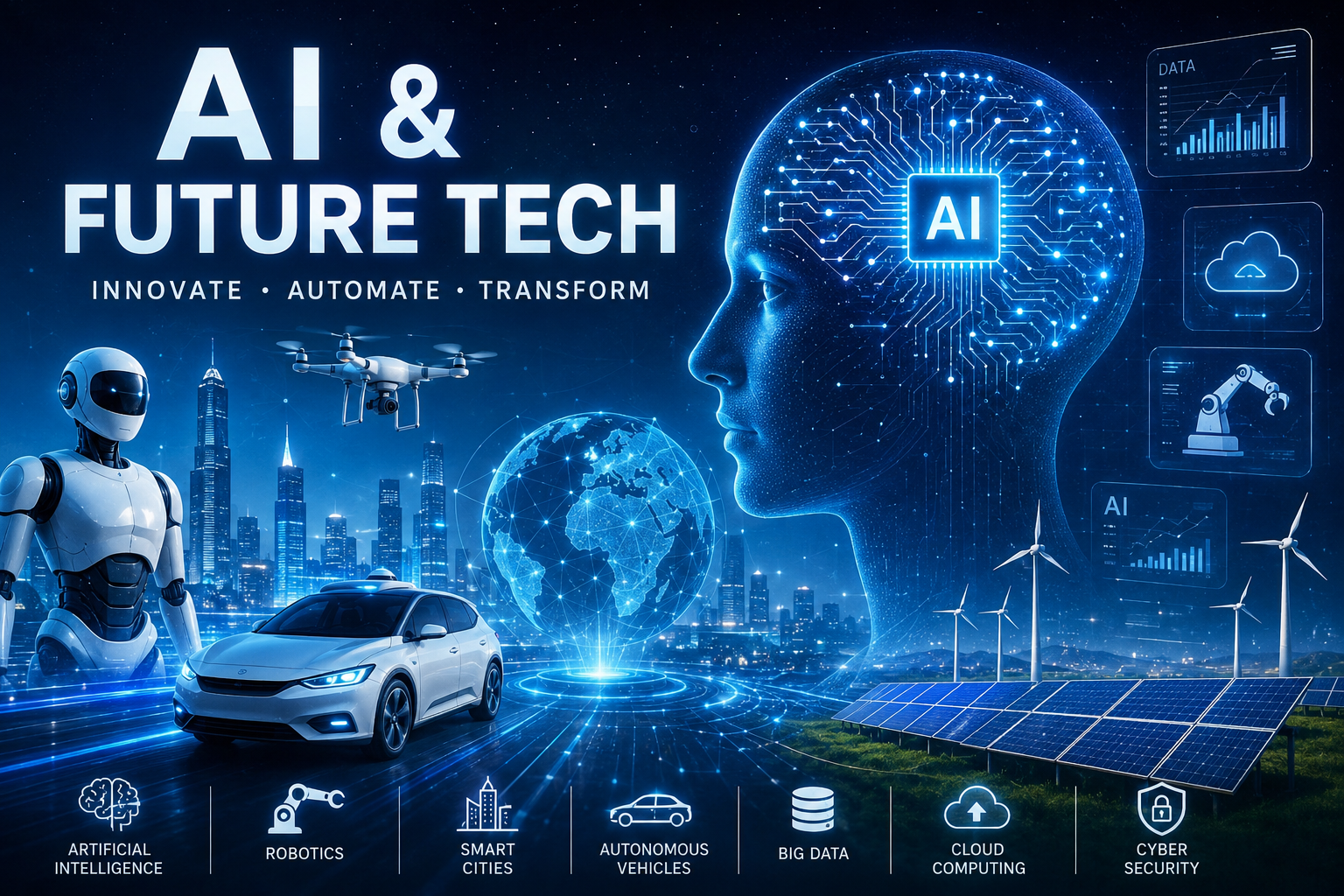
Artificial Intelligence refers to computer systems capable of performing tasks that traditionally require human intelligence. These tasks include learning, reasoning, problem-solving, language understanding, image recognition, and decision-making.
AI technologies rely heavily on data, algorithms, and computing power to analyze information and generate meaningful insights. Machine learning, deep learning, and neural networks are among the most important branches of artificial intelligence.
Today, AI is being integrated into smartphones, websites, online services, factories, educational platforms, and even household devices.
The Rise of Generative AI
One of the most exciting developments in recent years is Generative AI. Unlike traditional AI systems that analyze data and make predictions, generative AI can create entirely new content.
It can generate:
- Articles and blog posts
- Images and artwork
- Videos and animations
- Music compositions
- Software code
- Marketing content
Businesses are increasingly using generative AI tools to improve productivity, reduce costs, and accelerate innovation.
Content creators can produce high-quality materials within minutes, while developers can automate coding processes and identify software issues more efficiently.
Experts believe generative AI will become a major driver of economic growth over the next decade.
AI in Healthcare
Healthcare is among the sectors experiencing the greatest transformation through artificial intelligence.
AI-powered systems can analyze medical records, identify diseases, and assist doctors in making more accurate diagnoses.
Some major applications include:
Disease Detection
AI algorithms can detect diseases such as cancer, diabetes, and heart conditions at earlier stages, improving treatment outcomes.
Medical Imaging
Advanced systems analyze X-rays, MRI scans, and CT images with remarkable accuracy.
Drug Discovery
Researchers use AI models to discover potential medicines faster than traditional laboratory methods.
Personalized Treatment
Artificial intelligence enables healthcare providers to design treatment plans tailored specifically to individual patients.
As technology continues to evolve, AI has the potential to make healthcare more accessible, affordable, and efficient worldwide.
Smart Cities and Urban Innovation
Future cities will rely heavily on artificial intelligence and intelligent infrastructure.
Smart cities use connected devices, sensors, and data analytics to optimize urban services.
These technologies help improve:
- Traffic management
- Waste collection
- Energy consumption
- Public transportation
- Water distribution
- Emergency response systems
AI-driven traffic systems can reduce congestion, minimize fuel consumption, and enhance road safety.
Governments around the world are investing in smart city initiatives to create sustainable and efficient urban environments.
The Future of Education
Education is undergoing a significant transformation because of AI technologies.
Traditional classrooms are gradually evolving into smart learning environments.
Artificial intelligence supports education through:
Personalized Learning
AI systems analyze student performance and recommend customized learning paths.
Intelligent Tutoring
Virtual tutors provide instant feedback and assistance.
Automated Assessments
Teachers can save time by using AI tools to evaluate assignments and examinations.
Language Translation
Students can access educational materials in multiple languages.
These innovations have the potential to bridge educational gaps and provide quality learning opportunities to millions of people globally.
Robotics and Automation
Robotics combined with artificial intelligence is revolutionizing industries.
Modern robots can perform complex tasks with speed, precision, and efficiency.
Industries benefiting from AI-powered robotics include:
- Manufacturing
- Logistics
- Agriculture
- Healthcare
- Retail
- Construction
Autonomous robots can work continuously without fatigue, improving productivity and reducing operational costs.
Agricultural robots are helping farmers monitor crops, detect diseases, and optimize irrigation systems.
In warehouses, intelligent robots assist with inventory management and package sorting.
The future workforce is likely to involve increased collaboration between humans and intelligent machines.
Autonomous Vehicles
Self-driving vehicles represent another remarkable advancement in AI technology.
Companies around the world are investing heavily in autonomous transportation systems.
These vehicles use:
- Cameras
- Sensors
- GPS technology
- Machine learning algorithms
- Real-time data processing
Autonomous cars can potentially reduce road accidents caused by human error.
Future transportation networks may include:
- Self-driving taxis
- Autonomous trucks
- Smart public transportation
- AI-powered traffic control systems
Although challenges related to regulations, safety, and infrastructure remain, autonomous vehicles are expected to become increasingly common in the coming years.
Quantum Computing and AI
Quantum computing is considered one of the most promising future technologies.
Unlike traditional computers, quantum computers process information using quantum bits, also known as qubits.
This allows them to solve highly complex problems much faster than conventional systems.
Quantum computing could significantly enhance artificial intelligence capabilities by improving:
- Data analysis
- Optimization
- Scientific simulations
- Financial modeling
- Climate research
Researchers believe that the combination of AI and quantum computing may unlock discoveries that are currently beyond human capabilities.
Cybersecurity in the AI Era
As digital technologies continue expanding, cybersecurity has become more important than ever.
Artificial intelligence is being used both to defend against cyber threats and detect suspicious activities.
AI-powered security systems can:
- Monitor networks in real time
- Identify unusual behavior
- Prevent cyberattacks
- Detect malware
- Protect sensitive information
However, cybercriminals are also adopting advanced technologies.
This creates an ongoing challenge between security professionals and malicious actors.
Organizations must invest in AI-based cybersecurity solutions to stay ahead of evolving threats.
Space Exploration and AI
Artificial intelligence is playing an increasingly important role in space missions.
AI assists scientists and engineers in analyzing enormous amounts of data collected by satellites, telescopes, and spacecraft.
Applications include:
- Planetary exploration
- Satellite monitoring
- Navigation systems
- Mission planning
- Space research automation
Future space missions may depend heavily on intelligent systems capable of operating independently in distant environments.
AI could become a key factor in humanity’s efforts to explore Mars and beyond.
Ethical Challenges of Artificial Intelligence
Despite its many advantages, AI also raises important ethical questions.
Concerns include:
- Data privacy
- Job displacement
- Algorithmic bias
- Misinformation
- Security risks
- Responsible AI development
Governments, researchers, and technology companies are working together to establish regulations and ethical guidelines.
Ensuring transparency, accountability, and fairness in AI systems will be essential for sustainable technological progress.
What the Future Holds
Artificial intelligence is expected to become even more integrated into everyday life over the next decade.
Future innovations may include:
- AI-powered personal assistants
- Fully automated industries
- Advanced humanoid robots
- Intelligent healthcare ecosystems
- Smart homes
- Brain-computer interfaces
- Hyper-personalized digital experiences
Experts predict that AI could contribute trillions of dollars to the global economy while creating entirely new industries and opportunities.
However, success will depend on balancing innovation with ethical responsibility.
Conclusion
Artificial intelligence is no longer a technology of the future—it is already transforming the present. From healthcare and education to transportation, robotics, and space exploration, AI is reshaping the world at an extraordinary pace.
As emerging technologies continue to evolve, society must embrace innovation while ensuring that these advancements are used responsibly and for the benefit of humanity.
The future promises exciting possibilities, and artificial intelligence will undoubtedly remain at the center of technological progress. Understanding these developments today will help individuals, businesses, and nations prepare for a smarter, more connected, and more innovative tomorrow.